


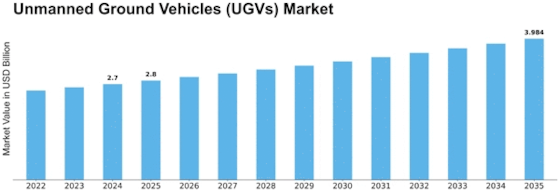
Modern warfare has undergone a major transformation fueled by digitalization, precision equipment, and autonomous systems. Nations are increasingly investing in unmanned ecosystems to reduce personnel vulnerability and improve operational tempo. In this context, Unmanned Ground Vehicles have emerged as critical assets for modernized defense capabilities. The Unmanned Ground Vehicles Market is projected to expand rapidly as militaries adopt robotic tools to enhance battlefield safety and situational awareness.
The most significant area of deployment lies in military UGV systems. These platforms are engineered to support a vast range of defense tasks, including ISR missions, explosive ordnance disposal, convoy escorting, border patrol, route clearance, equipment delivery, and tactical logistics. Their adaptability allows them to operate in urban environments, remote terrains, conflict regions, and chemically contaminated zones where human personnel face extreme danger.
Technological advancements have greatly improved the performance of UGVs in defense operations. Enhanced mobility, high-endurance batteries, hybrid propulsion, real-time video analytics, and encrypted remote command links are enabling safer and more productive missions. UGV systems can detect hidden threats, neutralize improvised explosive devices, and provide battlefield intelligence to support mission planning.
UGVs are also transforming supply chain management for military forces. Automated cargo transport minimizes the need for manned convoys, reducing exposure to ambush and roadside threats. Similarly, surveillance-centric UGVs extend the reach of soldiers, enabling persistent monitoring without continuous deployment of human scouts.
As defense forces move toward network-centric warfare models, UGVs are expected to be tightly integrated into command systems, unmanned aerial vehicles, and autonomous logistics ecosystems. The future battlefield will consist of multi-robot collaboration supported by artificial intelligence, robotic sensor networks, and autonomous tactical support units. The expansion of military UGV systems is not just improving safety — it is redefining the rhythm and operational geometry of modern combat.
Top Leading Key Players
Northrop Grumman (US), General Dynamics (US), BAE Systems (GB), Lockheed Martin (US), Oshkosh Defense (US), QinetiQ (GB), Textron (US), iRobot (US), Milrem Robotics (EE)
Table of Contents
SECTION I: EXECUTIVE SUMMARY AND KEY HIGHLIGHTS
SECTION II: SCOPING, METHODOLOGY AND MARKET STRUCTURE
SECTION III: QUALITATIVE ANALYSIS
SECTION IV: QUANTITATIVE ANALYSIS
SECTION V: COMPETITIVE ANALYSIS ........
FAQs
What is the current valuation of the Unmanned Ground Vehicles (UGVs) market?
The Unmanned Ground Vehicles (UGVs) market was valued at 2.7 USD Billion in 2024.
What is the projected market size for UGVs by 2035?
The market is projected to reach 3.984 USD Billion by 2035.
What are the primary mobility segments in the UGV market?
The primary mobility segments include Wheeled, Tracked, Hybrid, and Legged, with valuations ranging from 0.54 to 1.15 USD Billion.
Related Report:

 English
 French
 Spanish
 Portuguese
 Deutsch
 Turkish
 Dutch
Dutch
 Italiano
 Russian
 Romaian
 Portuguese (Brazil)
 Tiếng Việt