


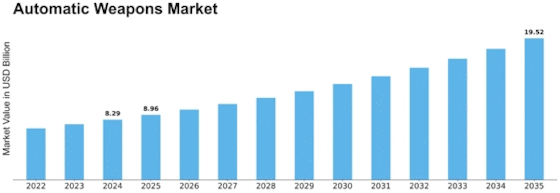
Across global defense bases, military transformation has accelerated sharply in response to emerging security threats and unpredictable conflict patterns. Tactical efficiency, troop protection, and continuous battlefield visibility have become core elements of modern combat readiness. To achieve these objectives, nations are prioritizing weapon systems that combine automation with precision control, enabling forces to respond swiftly to hostile actions while minimizing human risk.
This modernization movement is fueling remarkable growth in the Automatic Weapons Market, where automatic weapon systems are now considered indispensable components of present-day warfare. With the ability to engage targets rapidly and consistently, these systems offer unique benefits in both high-intensity conflicts and security operations. Their integration across infantry vehicles, naval combat platforms, aerial support fleets, and remote weapon stations underscores their importance in tactical and strategic missions.
Another key driver behind adoption is the operational versatility these systems provide. Unlike manual weaponry, automated firing platforms deliver stable accuracy across continuously changing environments — from open-terrain warfare to dense urban conflict zones. Automated systems ensure that soldiers retain full tactical command without physically positioning themselves at the point of engagement, significantly reducing exposure and improving mission survival rates.
Technological advancements are redefining automated weapon performance. Innovations such as recoil-optimized design, ballistic-computing fire control, advanced target-tracking modules, automated safety mechanisms, and smart optics are enhancing precision and firing stability. Many solutions now support modular upgrades, allowing military units to customize weapon capabilities for varying mission profiles without investing in entirely new systems.
Rising defense spending across developed and emerging nations further strengthens demand for automated firepower. Heightened border security concerns, growing counter-terrorism initiatives, and preparedness against asymmetric threats all contribute to long-term procurement plans. Defense agencies are prioritizing multi-platform automatic weapons to ensure consistent combat availability across land, air, and maritime units.
Looking ahead, technological maturity and battlefield automation are expected to expand adoption significantly. Future conflicts are predicted to involve greater reliance on autonomous ground and air support vehicles, AI-assisted fire control systems, and fully networked command ecosystems. Automatic weapons are set to remain at the forefront of this evolution, acting as a backbone of enhanced firepower, operational continuity, and national defense resilience. The future of warfare is increasingly defined by smart systems — and automated weapons will continue to play a central role in shaping the way militaries fight and protect.
Top Leading Key Players
Lockheed Martin (US), Northrop Grumman (US), General Dynamics (US), BAE Systems (GB), Rheinmetall (DE), Thales Group (FR), FN Herstal (BE), Heckler & Koch (DE), SIG Sauer (DE)
Table of Contents
SECTION I: EXECUTIVE SUMMARY AND KEY HIGHLIGHTS
SECTION II: SCOPING, METHODOLOGY AND MARKET STRUCTURE
SECTION III: QUALITATIVE ANALYSIS
SECTION IV: QUANTITATIVE ANALYSIS
SECTION V: COMPETITIVE ANALYSIS ........
FAQs
What is the projected market valuation of the Automatic Weapons Market by 2035?
The Automatic Weapons Market is projected to reach a valuation of 19.52 USD Billion by 2035.
What segment of the Automatic Weapons Market is projected to have the highest valuation by 2035?
The Automatic Rifles segment is projected to reach a valuation of 3.5 USD Billion by 2035.
How does the valuation of Light Machine Guns compare to Medium Machine Guns in 2035?
By 2035, Light Machine Guns are projected to be valued at 2.1 USD Billion, whereas Medium Machine Guns are expected to reach 1.9 USD Billion.
Related Report:

 English
 Arabic
 French
 Spanish
 Portuguese
 Turkish
 Dutch
Dutch
 Italiano
 Russian
 Romaian
 Portuguese (Brazil)
 Tiếng Việt