


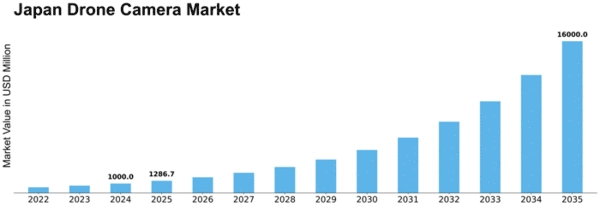
The Japan Drone Camera Market is accelerating toward unprecedented growth, driven by advancements in imaging technology, rising end-user adoption, and increasing commercial relevance. MRFR projects the Japan Drone Camera Market to grow from USD 1,000 million in 2024 to almost USD 16,000 million by 2035 — reflecting a soaring CAGR of 28.67%. This growth trajectory showcases not only rising demand but also the broadening scope of drone cameras within Japan’s economy. What began primarily as a tool for photography enthusiasts has evolved into an essential technology for industries such as construction, agriculture, media, logistics, environmental monitoring, and public infrastructure.
Much of this expansion is propelled by significant improvements in camera hardware. High-definition sensors are now the norm, enabling drones to capture crystal-clear images even in challenging lighting or weather conditions. Better gimbal stabilization, enhanced flight precision, and stronger processors have transformed drone cameras into reliable professional equipment capable of supporting critical business decisions. At the same time, manufacturers are designing lightweight, foldable, and user-friendly drones that appeal to consumers seeking high-quality aerial imagery without the complexities of traditional equipment.
Commercial operators form the largest and fastest-growing segment of the Japanese drone camera ecosystem. Construction and urban development firms use drone imagery to manage large-scale projects, document changes, and identify structural issues early. Agricultural operators rely on drone-based monitoring to optimize irrigation, monitor crop health, and reduce operational inefficiencies. Infrastructure agencies benefit from the ability to inspect hard-to-reach structures like tunnels, bridges, and remote installations, reducing both cost and risk. Meanwhile, the entertainment and media sectors continue to adopt drone cameras for professional cinematography, enhancing production quality with dynamic aerial perspectives.
AI integration amplifies these capabilities even further. With machine learning and automated analytics, drones can recognize objects, analyze visual patterns, avoid obstacles, and follow pre-programmed mission paths without manual control. This evolution from imaging tool to intelligent system expands their utility into areas such as surveillance, environmental conservation, and rapid disaster assessment. The potential for drones to support Japan’s disaster-management strategies is particularly valuable, given the country’s susceptibility to natural hazards.
Regulatory support strengthens market confidence. Japan’s government recognizes the value of drones in advancing industry and innovation, and its safety-first approach to drone regulations ensures smooth yet secure adoption. By promoting responsible usage while still enabling technology evolution, the regulatory environment helps push the market toward mass adoption.
As the nation moves toward 2035, the future of the Japan Drone Camera Market looks promising. The merging of HD imaging, AI, improved battery technologies, and diverse industry applications is driving continuous innovation. Drone cameras are no longer niche gadgets but integral components of Japan’s shift toward smarter infrastructure, digitized agriculture, automated inspection, and content-driven communication. The coming decade will define drone cameras as a key pillar of Japan’s digital transformation, shaping industries and influencing how visual data is captured and leveraged across the country.
More Report:
US Europe Electric Ships market

 English
 Arabic
 French
 Spanish
 Portuguese
 Turkish
 Dutch
Dutch
 Italiano
 Russian
 Romaian
 Portuguese (Brazil)
 Tiếng Việt